
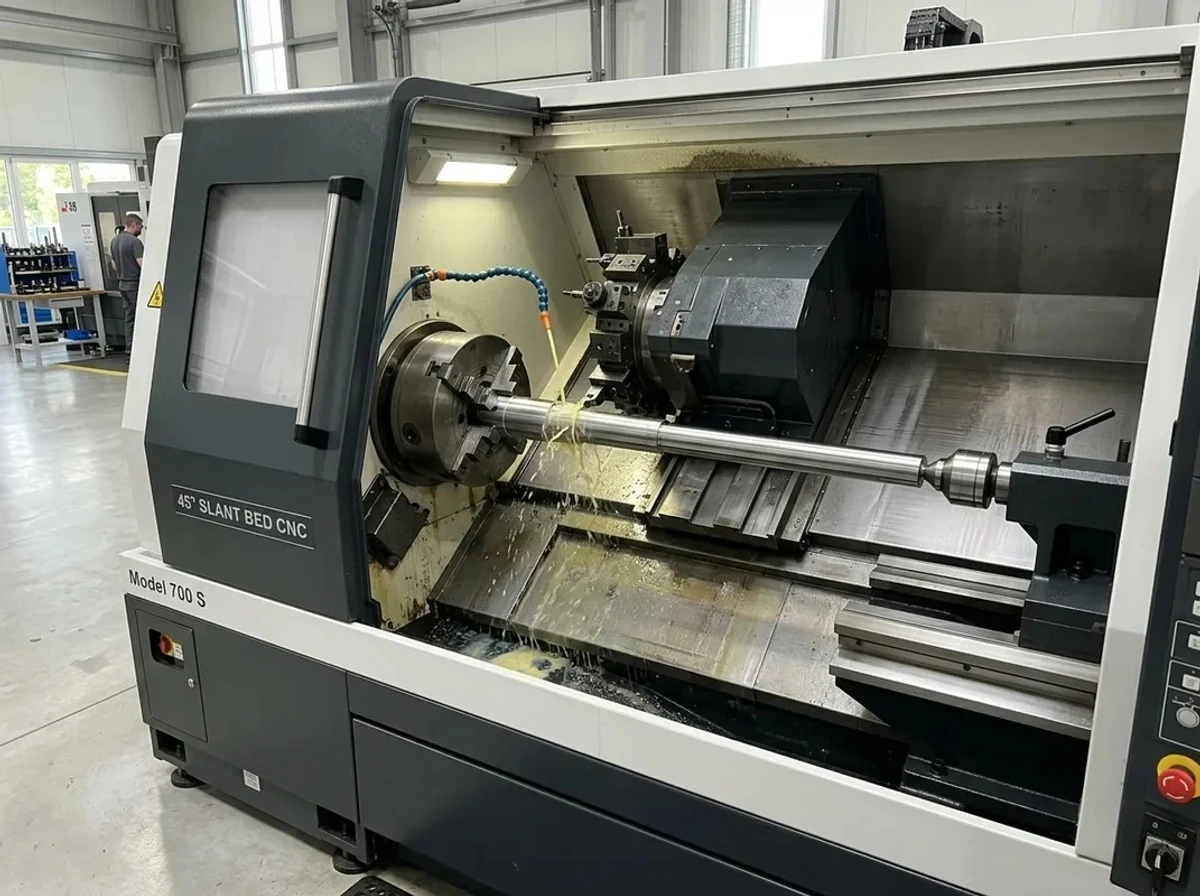
When investing in a CNC lathe, one of the most critical foundational decisions a manufacturing manager or machine shop owner faces is choosing between a Slant Bed CNC Turning Center (e.g., TCK Series) and a Flat Bed CNC Lathe (e.g., CK Series).
While both machine architectures turn round workpieces with computer numerical control, their physical kinematics, structural dynamics, and thermal behaviors differ radically. This guide breaks down the core mechanical differences and provides an actionable ROI framework to help you choose the right configuration for your specific production mix.
1. Structural Architecture & Cutting Force Vectors
The defining distinction between the two machine types lies in how the bedways are cast relative to the horizontal plane.
       FLAT BED CONFIGURATION                      SLANT BED (30°/45°) CONFIGURATION

             Tool Post                                    Spindle Centerline
                 ↓                                               /
           [Workpiece]                                      [Workpiece]
             ───────                                            /
          === Bedway ===                                   / (Cutting Force Vector)
         (Horizontal Plane)                               /
                                                    ============== Bedway
                                                  (Gravity & Force Aligned)
The Flat Bed Architecture (e.g., Qingluan CK6150)
In a flat bed lathe, the two main guide rails lie on a horizontal plane parallel to the floor. The spindle centerline, tool carrier, and tailstock all sit directly above the flat bedways.
- Strengths: Broad base footprint, straightforward mechanical assembly, lower manufacturing cost, and exceptional stability when supporting heavy, large-diameter billet loads (such as large pipes, flanges, and heavy forged cylinders).
- Limitation: The resultant cutting force generated during turning acts partially perpendicular to the bedway gravity plane, creating a torsional overturning moment on the saddle under aggressive depths of cut.
The True Slant Bed Architecture (e.g., Qingluan TCK50 / TCK52)
A true slant bed lathe features a monolithic casting inclined at either 30 degrees or 45 degrees.
- Vector Alignment: During external turning, the tangential and radial cutting forces point directly downward into the thickest, stiffest section of the triangular Meehanite cast-iron foundation.
- Dynamic Rigidity: Because the cutting forces push directly against the bed rather than trying to lift or twist the carriage, a slant bed lathe achieves over 40% higher dynamic stiffness, virtually eliminating chatter marks at high cutting feeds.
2. Chip Evacuation & Thermal Equilibrium
In continuous production turning, hot metal chips are the single biggest source of thermal errors and unexpected tool wear.
| Performance Metric | Flat Bed CNC Lathe (CK Series) | Slant Bed CNC Lathe (TCK Series) |
|---|---|---|
| Bed Inclination Angle | 0° (Horizontal) | 30° or 45° (Monolithic Slant) |
| Chip Disposal Mechanism | Chips drop onto horizontal bedway pans; manual rake or screw conveyor | Unobstructed gravity drop directly into high-capacity chain/hinge conveyor |
| Thermal Distortion Risk | Moderate to High (accumulated hot chips transfer heat into bed castings) | Minimal (chips leave the cutting zone within seconds of generation) |
| Max. Rapid Traverse | 6 – 10 m/min (Slideway friction limited) | 24 – 36 m/min (Preloaded roller linear guides) |
| Turret Indexing Time | 2.5 – 4.0 seconds (Electric tool post) | 0.15 – 0.3 seconds (High-speed hydraulic servo) |
| Live Tooling / Turn-Mill | Rare / Limited attachments | Native BMT/VDI integration with full C-axis spindle brake |
| Primary Production Suitability | Low-to-medium batch, MRO, large diameter parts, job shop | High-volume mass production, bar feeder automation, complex turned-milled parts |
Why Slant Bed Wins for High-Volume Production
When turning tough steels or aerospace superalloys, metal chips reach temperatures exceeding 600°C (1,100°F). On a horizontal flat bed, these chips settle around the saddle and guide rails, slowly heating the casting and causing dimensional drift of 15 to 30 microns over an 8-hour shift.
On a Qingluan TCK slant bed lathe, the 30°/45° incline ensures that every chip drops directly into the coolant trough and chip conveyor by gravity alone. The workpiece and critical guideways stay thermally isolated and geometrically stable.
3. Automation, Bar Feeding & Cycle Ergonomics
Modern manufacturing profitability relies on reducing cycle times and eliminating manual operator intervention.
- Integrated Bar Feeders & Parts Catchers: The slant bed layout leaves the front door area completely unobstructed. Short and long automatic bar feeders (1.5 m / 3.0 m) can feed raw stock continuously through the spindle bore, while a pneumatic parts catcher deposits finished parts into an external bin.
- Robotic Gantry Loading: Because the slant bed brings the chuck closer to the operator door, automated top-mount gantry arms or floor articulated robots can load and unload workpieces without interfering with tool turrets.
- Turn-Mill in a Single Setup: Models like the Qingluan TCK52 integrate driven live tooling stations and full C-axis spindle positioning (0.001°). This allows cross-drilling, bolt-hole circle milling, keyway cutting, and rigid tapping without moving the part to a secondary vertical machining center.
4. Total Cost of Ownership & ROI Decision Matrix
To select the most profitable machine for your factory, evaluate your production parameters using the following matrix:
YOUR PRODUCTION SCENARIO                                    RECOMMENDED CONFIGURATION
-------------------------------------------------------------------------------------
1. High-volume parts (>500 pcs/batch), automated bar feeding   -->  TCK50 / TCK52 Slant Bed
2. Complex parts needing turning + milling + radial holes      -->  TCK52 Turn-Mill Center
3. Large diameter billets (>400 mm), heavy forged shafts       -->  CK6150 / CK6160 Flat Bed
4. General job shop prototyping, maintenance, small batches    -->  CK6140 / CK6150 Flat Bed
5. Heavy oilfield pipe threading and flange facing             -->  CK6160 Large Bore
Capital Investment vs. Production Output
- Flat Bed Lathes (CK6140/CK6150) require approximately 40% less initial capital investment. For maintenance departments, repair shops, and toolrooms producing 10 to 50 parts per week, the flat bed delivers exceptional return on investment (ROI).
- Slant Bed Lathes (TCK50/TCK52) provide 2 to 3 times higher parts output per shift due to 30 m/min rapid feeds, sub-second tool indexing, and unmanned bar feeding. For batch manufacturing contracts, the cost per finished part is significantly lower.
Request an Application Engineering Review
Not sure which model configuration best suits your workpiece drawings and annual production volume? Send your component 2D/3D CAD drawings to our engineering desk at xiuc32860@gmail.com. Our application engineers will calculate estimated cycle times, tool layout recommendations, and provide a comprehensive factory quotation within 12 hours.